
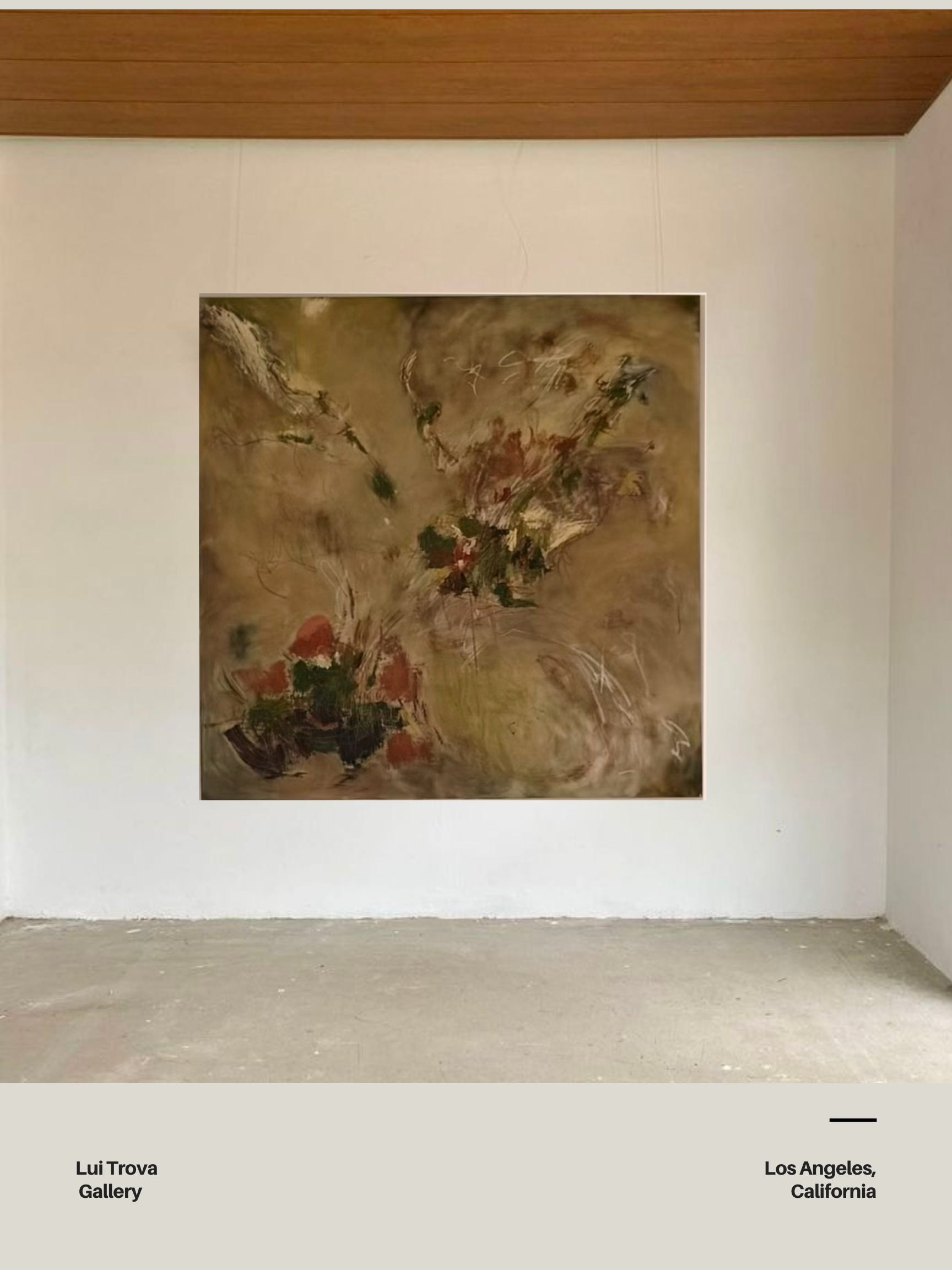
This essay accompanies the painting Transmutation, and reflects on transformation, pressure, and the movement of energy through material and body.
Transmutation
There is a moment when grief becomes physical.
Not metaphorically physical—physically located. The body knows exactly where it sits. Often it gathers in the abdomen, somewhere beneath the ribs where breath begins. It can feel dense there, almost architectural, as if something is being stored in the body that has not yet found its way out.
For a long time I believed the task was to get rid of that feeling. To resolve it. To metabolize it quickly so that the body could return to something like equilibrium.
But the longer I have lived with grief, the more I suspect that the body operates according to a different logic.
Energy does not disappear.
Physics tells us this plainly through the first law of thermodynamics: energy is neither created nor destroyed. It simply changes form or moves from one system to another.
The body appears to understand this law instinctively.
Emotions behave less like problems and more like currents. They gather, they circulate, they consolidate in certain regions of the body. When they are unable to move, they harden into pressure.
The painting Transmutation emerged from thinking about this movement.
The Body as a Vessel
One afternoon I was walking along the beach when I felt a familiar heaviness forming in my abdomen. It wasn’t sadness exactly. It was something denser—an accumulation of sensation that had nowhere to travel.
I kept walking, hoping movement alone would dissolve it. But the sensation remained. In fact it grew stronger, lodging itself deeper inside the body.
Eventually I stopped.
The tide was low and the beach was quiet. I began breathing slowly and moving through a few deliberate gestures—something resembling Tai Chi, though not formally. Just circular motions of the arms, gathering space around the body.
As I moved, I imagined the heaviness in my abdomen as something tangible. A compact sphere of energy.
I pictured lifting it slowly upward through the body—through the spine, through the center of the chest, past the throat and into the head. When it reached the top of the breath, I exhaled and released it outward.
The first attempt did nothing.
The second shifted something slightly.
By the third breath, the pressure in my abdomen had loosened.
Not disappeared—grief rarely disappears—but changed state.
What had been lodged began to move.
Transmutation
The word transmutation originally belonged to alchemy.
Alchemists believed substances could be transformed into new forms through a sequence of processes—heating, dissolving, recombining. While the mystical ambitions of alchemy were eventually replaced by chemistry, the underlying intuition was not entirely wrong.
Matter does change states.
Energy does convert.
Pressure does reorganize into different structures.
In the body, emotion behaves similarly.
We often treat certain emotions as moral problems. Anger becomes something to suppress. Grief becomes something to resolve as quickly as possible. Sadness becomes a signal that something is wrong.
But emotions are not errors in the system.
They are movements of energy.
What causes suffering is not the presence of emotion but the inability of that energy to circulate.
The body stores what it cannot process.
The abdomen tightens. The chest constricts. The breath shortens. Over time the body begins to carry its history physically.
Transmutation begins when movement returns.
Painting as a System of Circulation
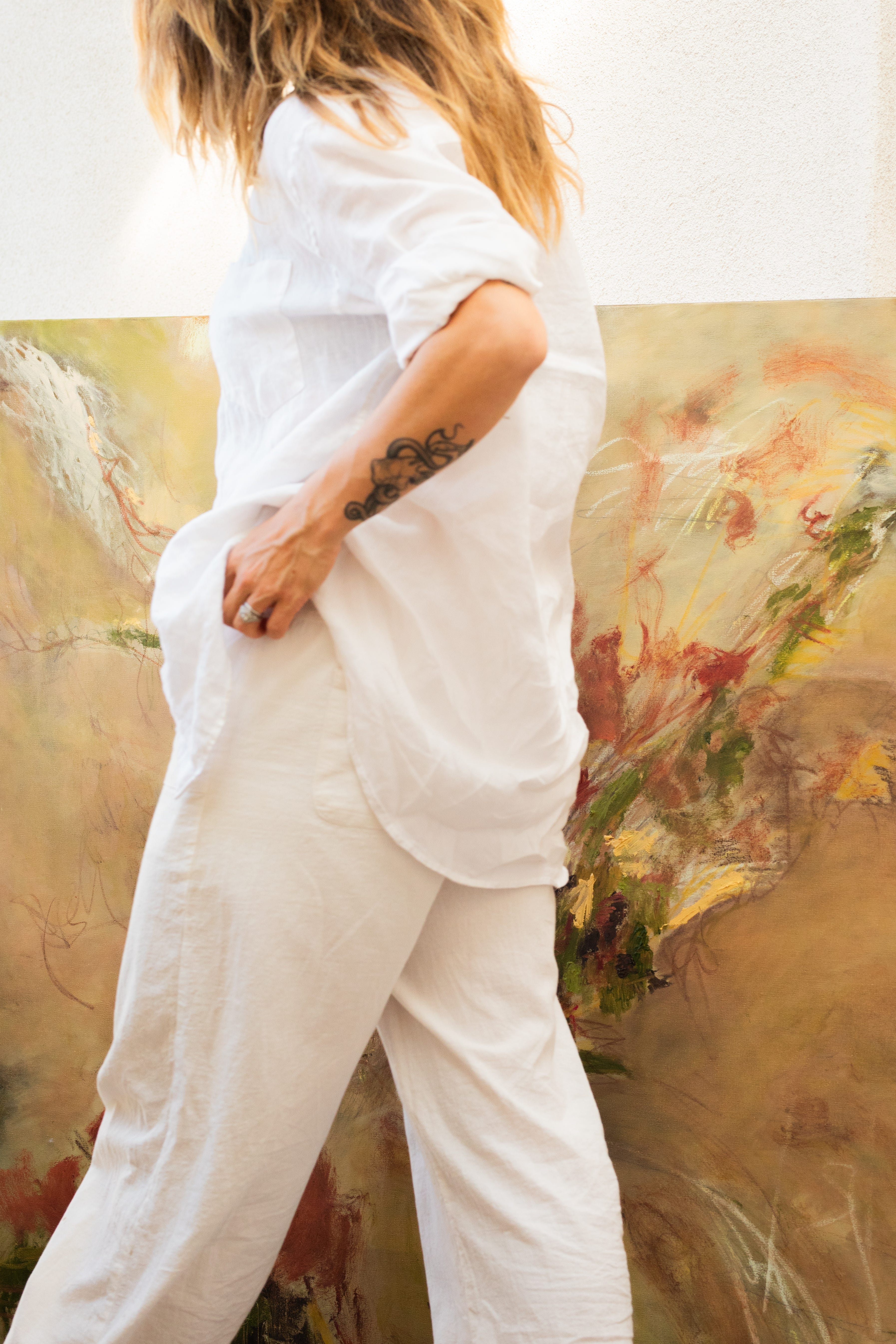
Painting operates according to a strangely similar logic.
A painting rarely begins with clarity. It begins with accumulation—layers of color, marks, gestures that appear and disappear. Over time these layers create pressure within the composition.
Some paintings remain sealed surfaces. Others eventually rupture.
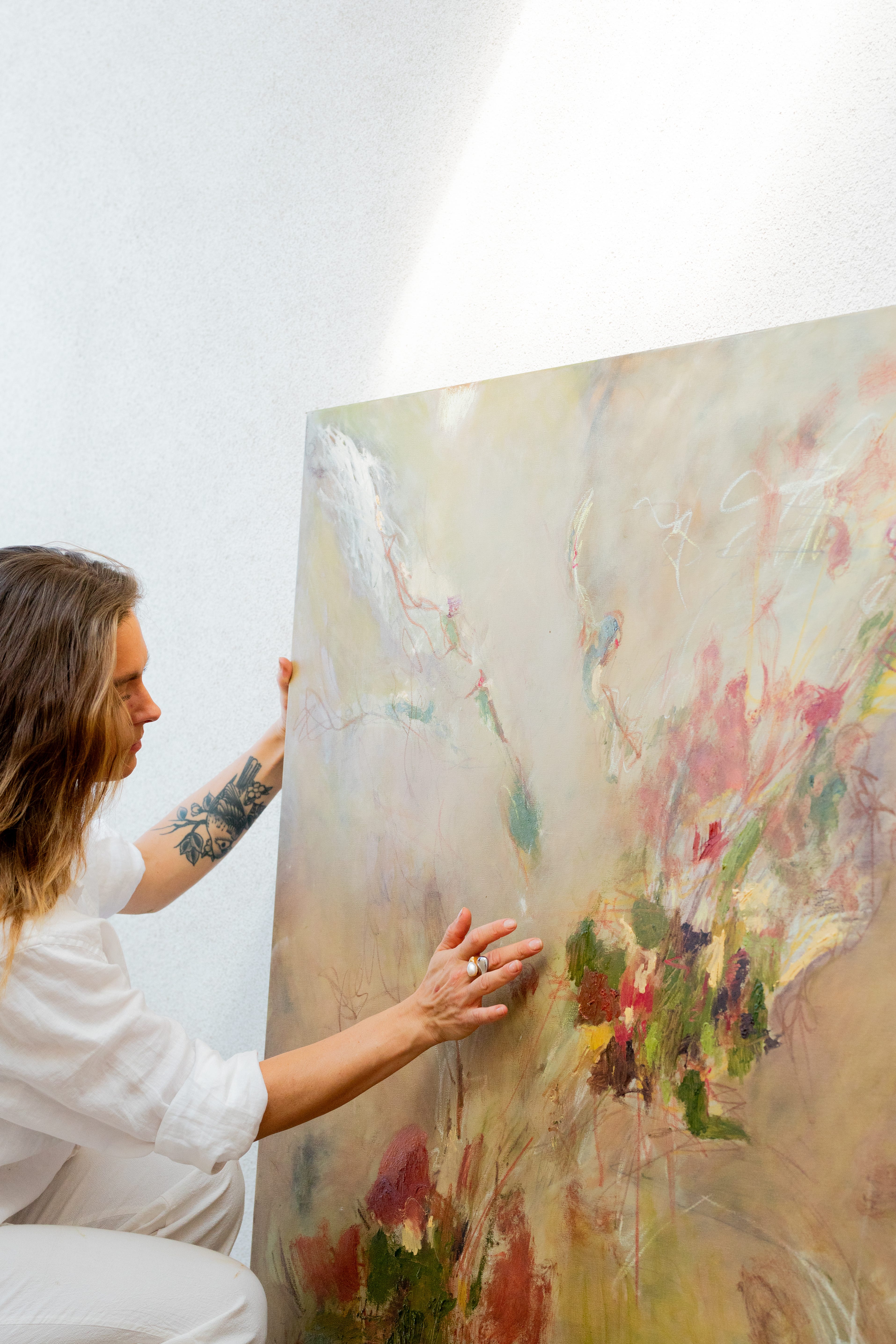
In Transmutation, the painting developed as a quiet atmospheric field—pale tones layered across the surface like fog or bone-colored sediment. Beneath those layers were darker pigments, mineral greens and reds that had been partially buried.
At some point a central cluster of gestures began to emerge.
It felt less like drawing and more like something pushing upward through the surface. Lines branched outward like vessels or roots. Color gathered and intensified.
The surrounding field remained calm.
Inside that calm, pressure accumulated until it found form.
In that sense the painting does not illustrate grief. It records a movement of energy through matter.
Paint holds pressure the way the body does.
Layers gather. Tension forms. Eventually something breaks through.
Not as destruction.
As release.
The Structure of Emotions
There is a tendency to divide emotions into positive and negative categories.
Happiness is desirable. Anger is undesirable. Grief is something to be endured until it fades.
But emotional life is structured by polarity.
Expansion and contraction. Attachment and loss. Lightness and weight.
The presence of one makes the other legible.
In physics, polarity creates movement. Electrical current flows between poles of potential difference. Atmospheric systems circulate through pressure gradients.
The body functions the same way.
Emotion is not a static state. It is a current moving through a living system.
What we call healing may simply be the restoration of that movement.
Matter Remembers
Oil paint has an unusually long memory.
Once applied, it holds every decision that has passed across the surface. Even when layers are covered, traces remain beneath them.
A painting therefore becomes a record of time.
The surface of Transmutation contains many stages of itself. Early layers of color remain buried beneath the pale ground. Certain gestures were erased and later returned in altered form.
What remains visible now is only the final configuration of a much longer process.
The same could be said of the body.
Every experience leaves some form of residue. The body stores those residues as posture, breath patterns, tension in muscles, shifts in perception.
We carry the record of our lives physically.
The question is not how to erase that record.
The question is how to allow it to move.
A Field of Conversion
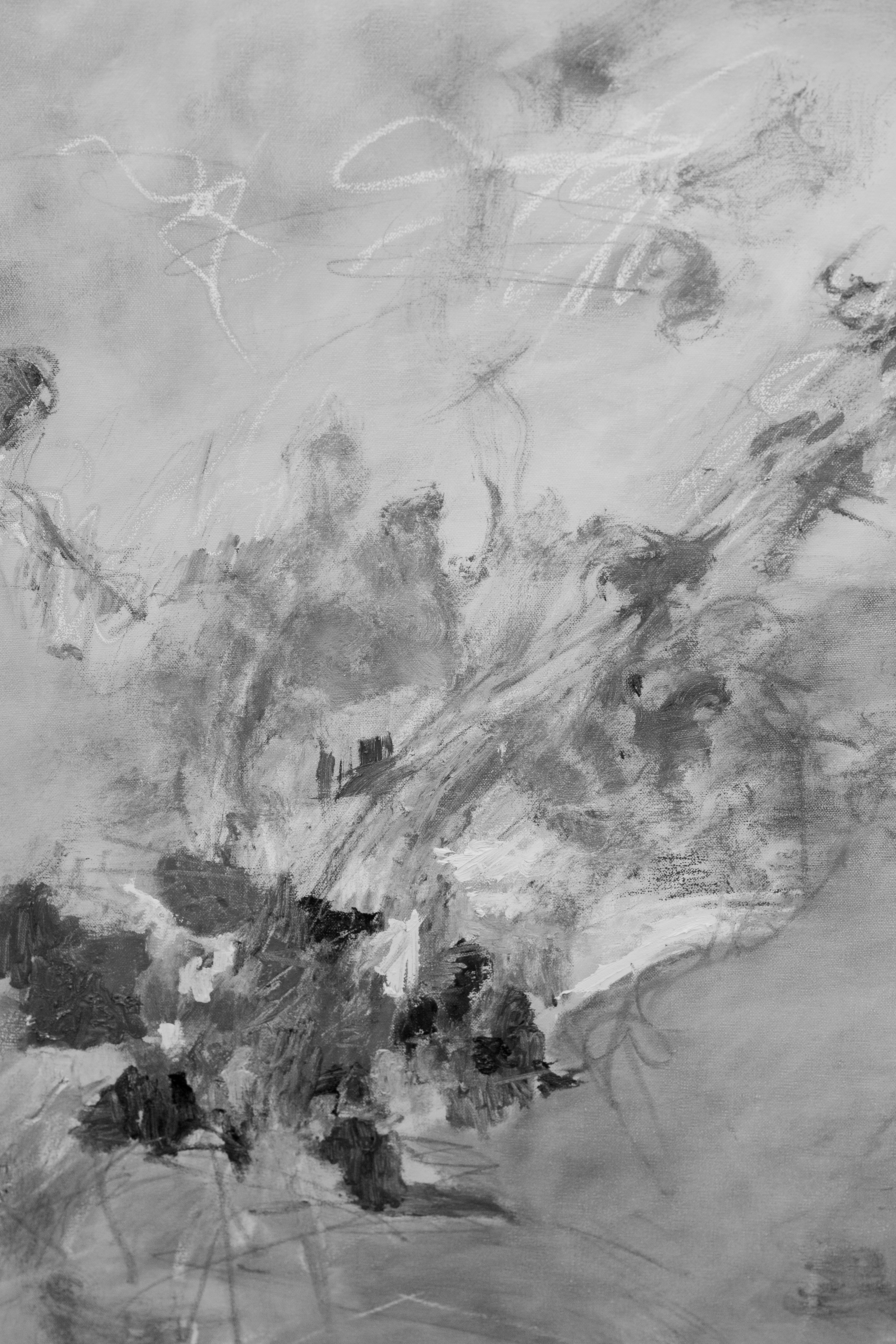
Standing back from the painting, what remains is a field.
A pale atmospheric ground holds a concentrated eruption of color and gesture at its center. The image oscillates between containment and release, between stillness and pressure.
It is not an illustration of an event.
It is the trace of a process.
Energy moving through a body.
Energy moving through paint.
Energy changing form.